The Problem: Capacity exists, but it is fragmented.
Most manufacturing capacity is managed shop by shop. That works until demand spikes, machines fail, or a job requires more throughput than one provider can handle.
I wanted to explore what would happen if capacity could be discovered, reserved, and coordinated across independent manufacturers while each shop still remained its own business.
The Idea: Treat distributed capacity like infrastructure.
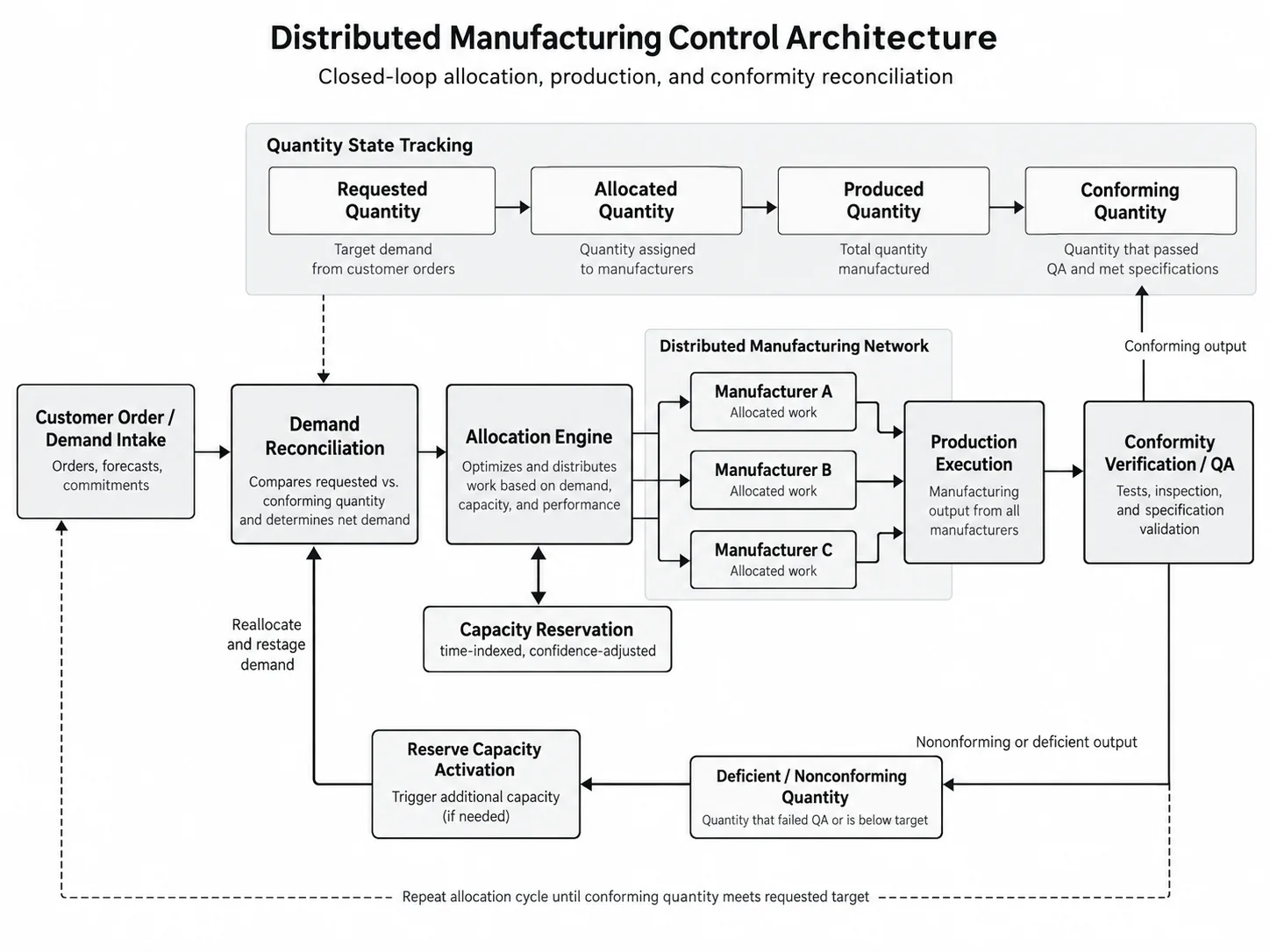
The architecture separates four states—requested, allocated, produced, and conforming quantity—so the system does not assume that assigning work means the job is actually complete.
If output is deficient, the missing quantity can be restored and reallocated without restarting the entire order. That closed loop is the part I care about most: allocation, verification, and recovery all belong in the same system.
The Future: Manufacturing becomes more decentralized.
I believe more production will eventually move across networks of shops, labs, and smaller automated systems rather than staying concentrated in a small number of centralized facilities.
The hard part is making that decentralized capacity dependable. This patent is meant to be one piece of that infrastructure: a coordination layer for capacity, reservations, verification, and failure recovery.
Why it connects directly to the PCB Fabricator.
Thinking about decentralized manufacturing is also what pushed me toward the Autonomous Desktop PCB Fabricator. One project asks how distributed capacity should be coordinated across a network. The other asks what one smaller autonomous node in that network might look like.